The Advantages of Reverse Engineering: Turning Physical Objects into Precise Digital Solutions
Introduction
In today’s fast-paced technological world, where customization and efficiency are essential, reverse engineering has become a critical tool for businesses, engineers, designers, and innovators. From reproducing discontinued parts to developing optimized prototypes, reverse engineering connects the physical and digital worlds.
At iPrintat, we use advanced 3D scanning, CAD modeling, and 3D printing technologies to transform real-world objects into precise, functional, and production-ready digital solutions.
What Is Reverse Engineering
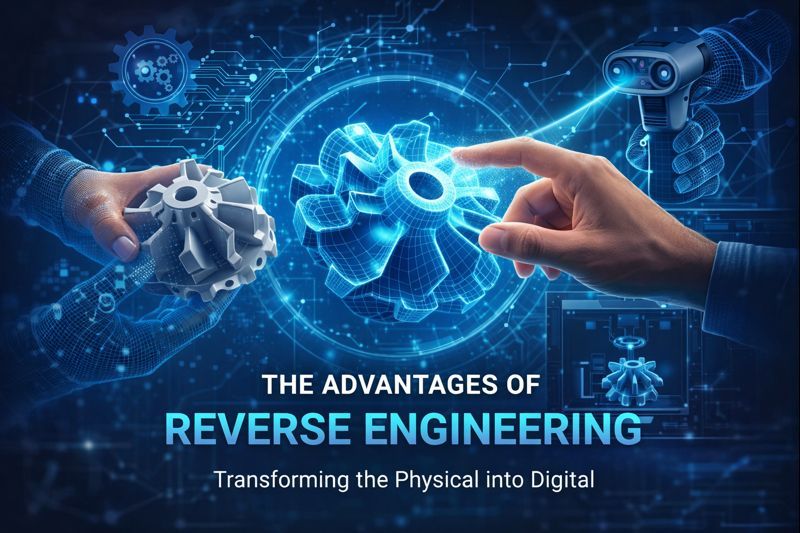
Reverse engineering is the process of analyzing an existing physical object and recreating it as an accurate digital 3D model. This model can then be modified, improved, reproduced, or integrated into larger projects.
A typical reverse engineering workflow includes:
- 3D scanning
- scan data processing
- precise CAD modeling
- prototyping or final production
Advantage 1 – Recreating Discontinued Parts
One of the most common uses of reverse engineering is reproducing parts that are no longer available. This is especially useful for:
- industrial machinery
- legacy equipment
- classic vehicles
- custom components
Reverse engineering allows these parts to be recreated with high accuracy, even without original drawings.
Advantage 2 – Time and Cost Efficiency
Designing a component from scratch is time-consuming and expensive. Reverse engineering significantly reduces development time and costs while minimizing design risks.
At iPrintat, our streamlined workflow ensures fast and efficient project delivery.
Advantage 3 – Product Optimization
Reverse engineering is not just about duplication; it enables improvement. Once digitized, a component can be:
- structurally reinforced
- weight-optimized
- redesigned for better performance
- adapted for new applications
- prepared for production
Advantage 4 – Perfect Fit and Compatibility
Many components must fit seamlessly into existing assemblies. Reverse engineering ensures precise tolerances and accurate alignment, which is essential in:
- electronics
- precision mechanics
- robotics
- automotive applications
Advantage 5 – Full Customization
Off-the-shelf components do not always meet specific requirements. Reverse engineering enables fully customized solutions tailored to each project’s needs.
The Role of 3D Scanning
3D scanning is the foundation of reverse engineering. It captures exact geometry and fine details, ensuring faithful digital reproduction of the original object.
Reverse Engineering and 3D Printing
Once the CAD model is complete, it can be 3D printed for:
- functional prototypes
- end-use parts
- enclosures
- adapters
- custom mounts
3D printing provides unmatched flexibility and cost efficiency for low-volume production.
Application Areas
Reverse engineering is widely used in:
- manufacturing
- automotive and motorcycle industries
- electronics
- research and development
- design and restoration
Why Choose iPrintat
At iPrintat, we offer a complete service:
- high-precision 3D scanning
- professional CAD modeling
- high-quality 3D printing
- technical consulting
- custom-tailored solutions
Conclusion
Reverse engineering is one of the most powerful modern tools for repairing, improving, and customizing physical products. Combined with 3D scanning and 3D printing, it enables faster innovation and reliable production.
If you want to turn a physical object into a precise digital solution, iPrintat is your trusted partner.