Sensors for microcontrollers
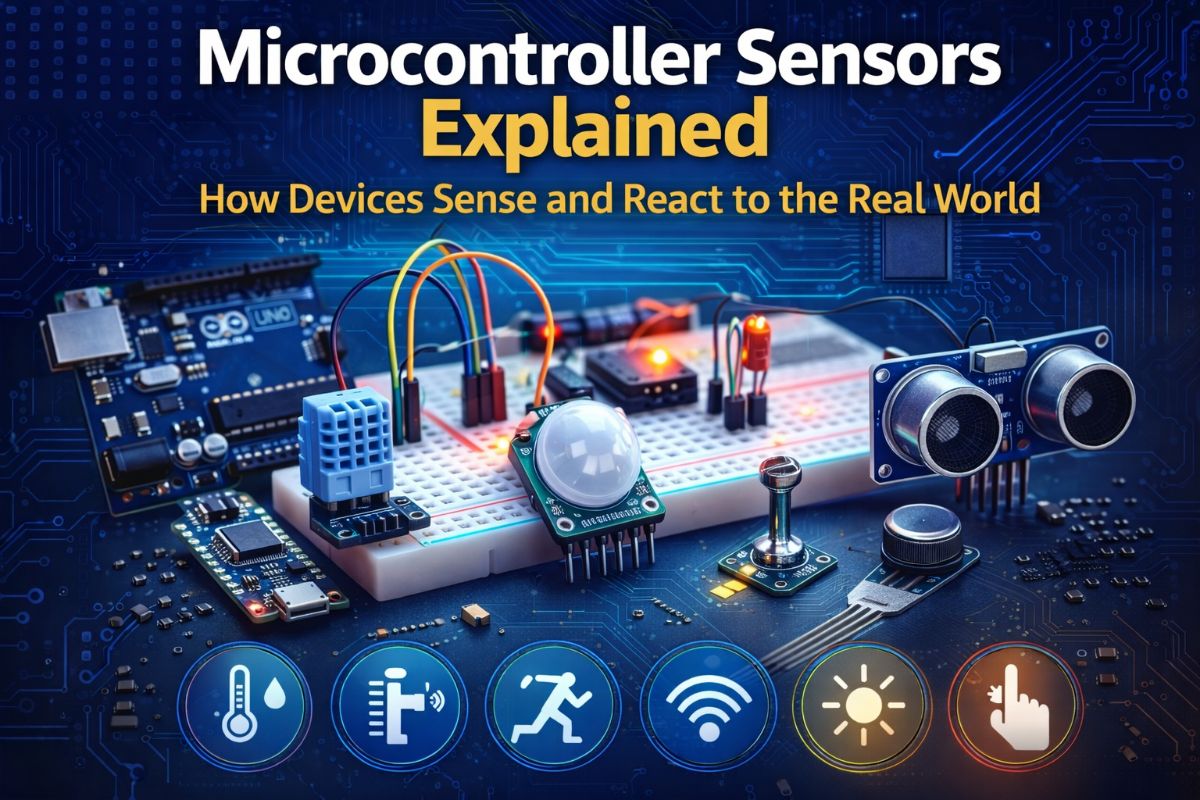
Microcontroller Sensors Explained: How Devices Sense and React to the Real World
Introduction
Microcontrollers alone are powerful, but sensors are what allow them to understand and interact with the physical world. From measuring temperature and motion to detecting light, distance, or pressure, sensors transform real-world conditions into digital signals.
At iPrintat, we integrate sensors with microcontrollers to build smart, responsive, and reliable electronic systems — from simple monitoring devices to complex automation solutions.
What Is a Sensor?
A sensor is an electronic component that detects a physical property and converts it into a signal that a microcontroller can process.
Common measurable properties include:
temperature
humidity
light intensity
distance
motion
pressure
gas concentration
touch or force
Sensors act as the inputs of an embedded system, enabling data-driven decisions.
How Sensors Work with Microcontrollers
The typical sensor workflow is simple but powerful:
The sensor measures a physical value
The signal is converted into an electrical output
The microcontroller reads the signal via GPIO, ADC, or communication bus
Firmware logic processes the data
The system reacts (control, alert, log, transmit)
This loop allows devices to sense → decide → act in real time.
Common Types of Microcontroller Sensors
Temperature and Humidity Sensors
Used for:
climate monitoring
smart thermostats
electronics protection
Examples:
DHT series
digital temperature sensors
environmental sensor modules
Motion and Presence Sensors
Used for:
security systems
automatic lighting
occupancy detection
Common technologies:
PIR sensors
accelerometers
gyroscopes
Distance and Proximity Sensors
Used for:
object detection
robotics
collision avoidance
level measurement
Technologies include:
ultrasonic
infrared
time-of-flight sensors
Light Sensors
Used for:
ambient light detection
automatic brightness control
solar tracking systems
Examples:
photoresistors (LDR)
photodiodes
light intensity sensors
Pressure and Force Sensors
Used for:
load detection
industrial monitoring
user input systems
Includes:
force-sensitive resistors
pressure transducers
Analog vs Digital Sensors
Feature
Analog Sensors
Digital Sensors
Output
Variable voltage
Digital data
Processing
Requires ADC
Built-in processing
Noise sensitivity
Higher
Lower
Wiring
Simple
Protocol-based
Accuracy
Depends on ADC
Typically higher
Choosing between analog and digital sensors depends on precision, complexity, and system design.
Sensor Communication Protocols
Many sensors communicate using standardized protocols:
Analog input (ADC) – simple voltage-based sensors
I²C – multiple sensors on shared lines
SPI – high-speed, short-distance communication
UART – serial communication
Platforms like Arduino and ESP32 natively support these protocols, making sensor integration efficient and scalable.
Challenges When Working with Sensors
Noise and Interference
Poor wiring, power instability, or environmental factors can affect readings.
Calibration
Many sensors require calibration for accurate results.
Power Management
Battery-powered systems need low-power sensors and sleep strategies.
Environmental Constraints
Temperature, humidity, dust, and vibration can impact sensor performance.
At iPrintat, we design systems that account for these real-world constraints.
Sensors and Enclosure Design
A sensor is only as good as its placement and housing. Proper design ensures:
accurate exposure to measured variables
protection from damage
reliable long-term operation
Using 3D-printed enclosures, we create:
sensor mounts
protective housings
weather-resistant casings
integrated assemblies
Applications of Sensor-Based Systems
Sensor-integrated microcontroller systems are used in:
smart homes
industrial automation
environmental monitoring
robotics
agriculture
consumer electronics
research and prototyping
These systems form the backbone of modern IoT and automation solutions.
Why Choose iPrintat for Sensor-Based Projects?
At iPrintat, we provide:
sensor selection and integration
microcontroller programming
signal conditioning and calibration
electronics prototyping
custom 3D-printed enclosures
full system testing
We focus on functional, reliable, and scalable designs, not just demos.
Conclusion
Sensors give microcontrollers awareness of the physical world, enabling intelligent behavior and automation. When correctly selected, integrated, and protected, they transform simple electronics into powerful systems.
If you’re planning a sensor-based project or need a complete embedded solution, iPrintat is ready to help you build it — from concept to deployment.
Tags
microcontroller sensors
embedded sensors
Arduino sensors
ESP32 sensors
IoT sensing
electronics prototyping
automation systems